What Every American Should Know About the Waterway That Moves Their World
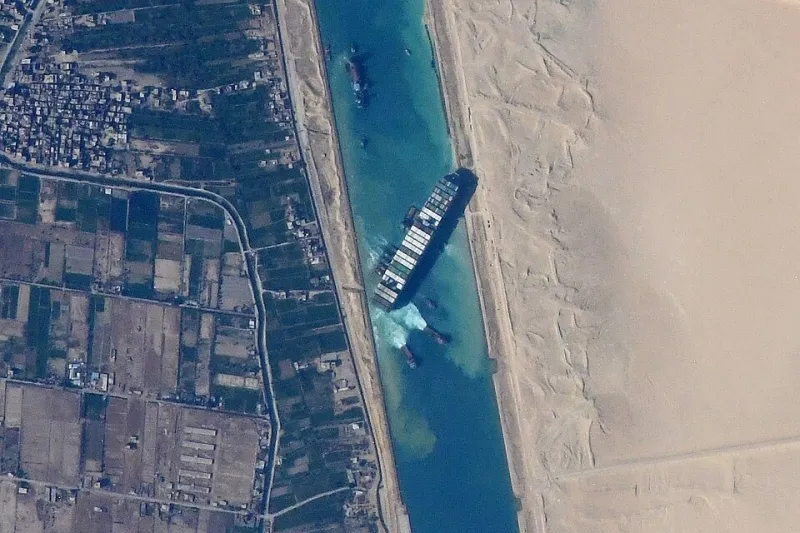
Photo: NASA JSC ISS image library, Public domain, via Wikimedia Commons
Picture this: It's March 2021. You're scrolling through your news feed and suddenly a photo stops you cold. A ship — and we're talking a vessel longer than the Empire State Building is tall — is wedged sideways across a canal in Egypt, completely blocking traffic. Late-night hosts are cracking jokes. Memes are flying. But behind the laughs, supply chain managers across the United States are quietly panicking.
That ship was the Ever Given. That canal was the Suez. And that six-day blockage cost the global economy an estimated $9.6 billion per day in delayed trade. For many Americans, it was the first time they'd really stopped to think about this narrow strip of water in northeastern Egypt — and just how much of their daily life depends on it flowing freely.
Welcome to Port Said, the city that sits at the northern mouth of the Suez Canal. This is where the Mediterranean meets one of the most consequential engineering achievements in human history. And if you want to understand global trade — really understand it — this is the place to start.
A Canal Born from Colonial Ambition
The Suez Canal didn't just appear. It was carved out of the Egyptian desert between 1859 and 1869 under the direction of French diplomat Ferdinand de Lesseps, using a workforce of Egyptian laborers who endured brutal conditions to make it happen. When it finally opened on November 17, 1869, it fundamentally rewired global commerce.
Before the canal, ships traveling between Europe and Asia had to sail all the way around the southern tip of Africa — Cape of Good Hope — adding thousands of miles and weeks to every voyage. The Suez Canal cut that journey dramatically. Suddenly, London to Mumbai shrank from roughly 10,700 nautical miles to about 6,200. The math was undeniable, and the world's shipping lanes reorganized almost overnight.
For the United States, which was still rebuilding from the Civil War and rapidly industrializing, the canal opened new lanes of commerce with Asia and East Africa. American cotton, wheat, and manufactured goods could reach new markets faster. Imports from India, China, and the Far East became more accessible and, eventually, more affordable.
Britain, Egypt, and the Canal That Sparked a Crisis
The canal's history isn't just about trade — it's about power. Britain purchased a controlling stake in the Suez Canal Company in 1875 and effectively used it as a lever of imperial influence for decades. That arrangement held until 1956, when Egyptian President Gamal Abdel Nasser nationalized the canal in a move that sent shockwaves through Western capitals.
What followed — the Suez Crisis — pulled in Britain, France, Israel, the United States, and the Soviet Union in a geopolitical standoff that reshaped the post-World War II order. The US, under President Eisenhower, pressured Britain and France to back down, a decision that signaled a major shift in global power dynamics. The canal has been under Egyptian control ever since, managed today by the Suez Canal Authority.
For Americans visiting Port Said, this history isn't abstract. You can feel it in the city's colonial-era architecture, in the museums, and in the pride locals take in 1956 as a defining national moment.
The Numbers That Put It in Perspective
Let's talk scale, because the Suez Canal's economic footprint is almost hard to comprehend.
Approximately 12 to 15 percent of all global trade passes through the canal annually. That includes roughly 30 percent of global container traffic. In 2023 alone, over 25,000 vessels made the transit, carrying everything from crude oil and liquefied natural gas to consumer electronics, automobiles, and agricultural commodities.
For American consumers, the canal is a direct line between factory floors in Asia and store shelves in the US. Electronics assembled in Vietnam, clothing manufactured in Bangladesh, machinery built in Germany — a significant chunk of it comes through the Suez. When transit is disrupted, the ripple effects show up as shipping delays, inventory shortages, and ultimately, higher prices.
"The Ever Given incident was a wake-up call," said one logistics consultant who works with mid-sized US importers. "Businesses that had never thought about the Suez Canal before suddenly had executives Googling where it was. It made supply chain vulnerability very real, very fast."
The Ever Given: A Masterclass in Interconnectedness
The Ever Given grounding on March 23, 2021 lasted just six days, but its consequences stretched for months. An estimated 369 ships were backed up waiting to transit when the blockage was finally cleared. The cargo those ships were carrying — worth an estimated $54 billion in total — included everything from IKEA furniture to livestock.
US retailers felt the pinch almost immediately. Shipping container costs, which had already been climbing due to pandemic-era disruptions, spiked further. Some importers reported waiting months for goods that would normally arrive in weeks. The incident became a vivid illustration of how a single chokepoint can rattle supply chains across continents.
The Suez Canal Authority has since invested heavily in widening and deepening sections of the canal to reduce the risk of future groundings. A second parallel channel, partially completed in earlier expansion projects, has also improved traffic flow. Still, the event underscored what shipping experts have long argued: the canal remains one of the world's most critical — and most vulnerable — infrastructure assets.
Why Port Said Is Your Best Window Into All of This
Sitting at the canal's Mediterranean entrance, Port Said offers something no textbook or documentary can fully replicate: the experience of watching this global artery in real time. From the city's waterfront corniche, you can watch massive container ships glide past at close range — vessels so large they seem impossibly out of place against the low skyline of the city.
The Canal House, built in 1869 and one of the oldest buildings in Port Said, offers historical exhibits about the canal's construction and operation. The city's Maritime Museum provides additional context, with artifacts and displays tracing the waterway's evolution from a 19th-century engineering marvel to a 21st-century economic lifeline.
Local guides will often point out that Port Said itself was essentially built alongside the canal — the city and the waterway grew up together, which gives residents a particular sense of ownership over its legacy. Ask a Port Saidi about the 1956 nationalization and you'll likely get a passionate, detailed response.
What Happens Here Affects Your Grocery Bill
It's easy to think of global trade as an abstraction — something that happens far away and doesn't really touch everyday life. The Suez Canal makes that abstraction impossible to sustain.
When Houthi attacks in the Red Sea began targeting commercial shipping in late 2023, many vessels started rerouting around Africa to avoid the risk. That added roughly two weeks to transit times and significantly increased fuel costs. The result? Shipping rates surged, and analysts warned of potential price increases for consumer goods across Western markets, including the US.
This is the canal's quiet power. It doesn't make headlines on ordinary days. But when something goes wrong here — whether it's a grounded ship, a regional conflict, or a political standoff — Americans feel it, even if they can't quite name the source.
Standing on the Port Said waterfront and watching a laden container ship ease into the canal, you start to feel the weight of that connection. This isn't just Egypt. This is the engine room of global commerce, and it's worth understanding.