Roots in the Harbor: The Egyptian Merchant Dynasties Who Turned Port Said Into a Global Trade Powerhouse
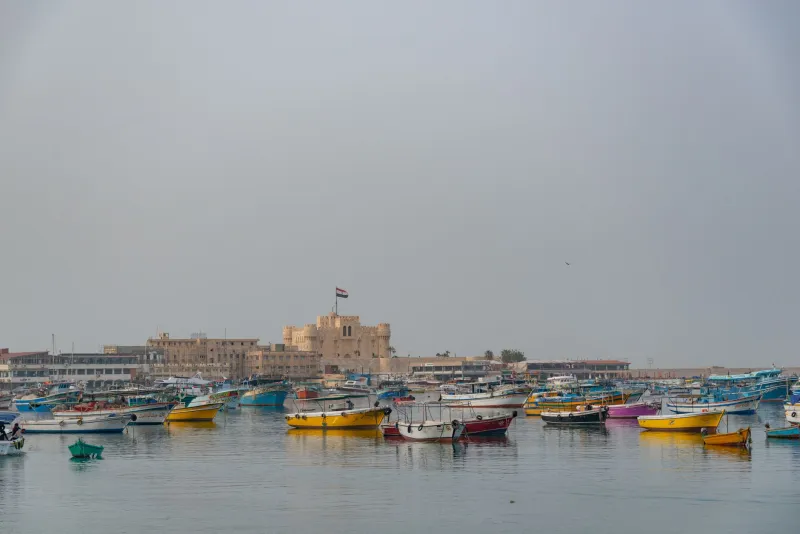
Port Said didn't become one of the world's most strategically important shipping cities by accident. Yes, the geography helped — sitting at the northern mouth of the Suez Canal, straddling two continents, connecting the Mediterranean to the Red Sea. But geography alone doesn't build a port. People do. And in Port Said's case, a surprisingly small number of interlocking family dynasties did a disproportionate amount of the heavy lifting.
For American travelers visiting the city today, the legacy of these merchant families is everywhere — in the grand colonial-era buildings lining the harbor, in the names etched above warehouses and shipping offices, and in the living descendants who still run businesses their great-grandparents started when the canal was barely a decade old.
A City Built on Ambition and Salt Water
When the Suez Canal opened in 1869, Port Said was essentially a construction camp — a temporary city that had sprung up to house the workers digging one of history's most audacious engineering projects. Within a decade, though, entrepreneurs began to see what the location could become: a mandatory refueling and resupply stop for virtually every ship moving between Europe and Asia.
The families who moved fast — establishing coal depots, provisioning services, chandleries, and brokerage houses — essentially locked in a century's worth of commercial advantage. Among the most prominent were Greek, Italian, Jewish, and Egyptian Arab merchant clans who collectively turned this canal-mouth city into a cosmopolitan trading hub unlike anything else in the region.
"My grandfather used to say that Port Said was the most international city in the world before anyone used that word," says Karim Mansour, a third-generation shipping agent whose family firm still operates out of an office overlooking the harbor. "He knew people from thirty countries before he was twenty-five years old, all because of this canal."
The Coal Kings and What Came After
In the canal's early decades, coal was king. Steam-powered ships needed enormous quantities of it, and whoever controlled the coal supply in Port Said controlled a critical chokepoint in global trade. Several Egyptian and Levantine families built their initial fortunes supplying fuel to vessels transiting the canal, often undercutting European competitors by operating leaner, locally rooted businesses.
The Farouk family — not to be confused with the Egyptian royal — is one example. Starting as coal merchants in the 1880s, they gradually diversified into ship chandlering (supplying provisions to crews), then into customs brokerage, and eventually into freight forwarding. Today, the fourth generation runs a logistics company that coordinates shipments between Egyptian ports and destinations across North America.
"We've had to reinvent ourselves every thirty years or so," says Nadia Farouk, who heads the family's international division. "Coal became oil. Oil became containers. Containers became data. But the core of what we do — making sure ships and cargo move smoothly through this port — that hasn't changed in 140 years."
That continuity matters more than it might seem to American consumers. When a clothing manufacturer in Bangladesh ships a container to a retailer in Ohio, there's a decent chance it transits Port Said, and a reasonable chance that some part of the documentation, customs clearance, or local logistics involves a firm with roots stretching back to the canal's earliest commercial era.
The Cosmopolitan Web
One thing that distinguishes Port Said's merchant history from similar stories in other port cities is how deeply intertwined the various family networks became — across ethnic and religious lines that might have kept them apart elsewhere. Greek shipping families partnered with Egyptian Arab provisioners. Jewish merchants brokered deals between Italian chandlers and British coal importers. The canal created a kind of commercial pressure that pushed people toward cooperation.
"There was a pragmatism to it," explains Dr. Heba Rashid, a historian at the Suez Canal University who has spent years documenting Port Said's commercial genealogy. "If a ship was arriving at three in the morning and you needed a chandler, a customs agent, and a pilot all at once, you didn't have time for prejudice. You worked with whoever was reliable."
That web of relationships — maintained over generations through marriages, partnerships, and shared professional guilds — gave Port Said's merchant community a resilience that helped it survive wars, nationalizations, and economic upheavals that would have destroyed less interconnected business ecosystems.
Nationalization and Reinvention
The 1950s and 60s brought enormous disruption. Egypt's nationalization of the Suez Canal in 1956 and the broader economic reforms of the Nasser era forced many of the city's foreign merchant families to leave, and placed significant constraints on private enterprise. Several of the old dynasties lost assets, dissolved partnerships, or relocated to Alexandria, Cairo, or abroad.
But some families navigated the transition by embedding themselves more deeply in the new state-dominated economy — taking roles in the Suez Canal Authority, in state shipping enterprises, or in the free trade zones that Egypt gradually developed around Port Said in subsequent decades.
"My father always said that the canal belongs to Egypt, and so do we," says Ahmed El-Sayed, whose family shifted from private freight brokerage to managing warehousing operations within Port Said's free trade zone after nationalization. "We didn't fight it. We found where we fit in the new structure."
That adaptability — a recurring theme in conversations with Port Said's business families — is perhaps the most durable inheritance these dynasties have passed down.
What It Means for the City Today
For visitors to Port Said, this layered commercial history adds a dimension to the city that isn't always obvious from the tourist-facing surface. The harbor isn't just a scenic backdrop — it's a living artifact of centuries of mercantile ambition. The old building facades along the corniche, the multilingual street names, the diversity of faces in the markets: all of it reflects the cosmopolitan merchant culture that these families helped create.
If you get a chance to sit down with a local businessperson — and Port Said is a city where that kind of conversation happens naturally, over tea in a harbor-front café — ask them about their family. The chances are good you'll hear a story that connects directly to the canal's earliest commercial era, and indirectly to the global supply chains that stock American shelves today.
The families who built this port were betting on a geographic idea — that the world would always need a faster route between its oceans. A hundred and fifty years later, that bet still looks pretty good.