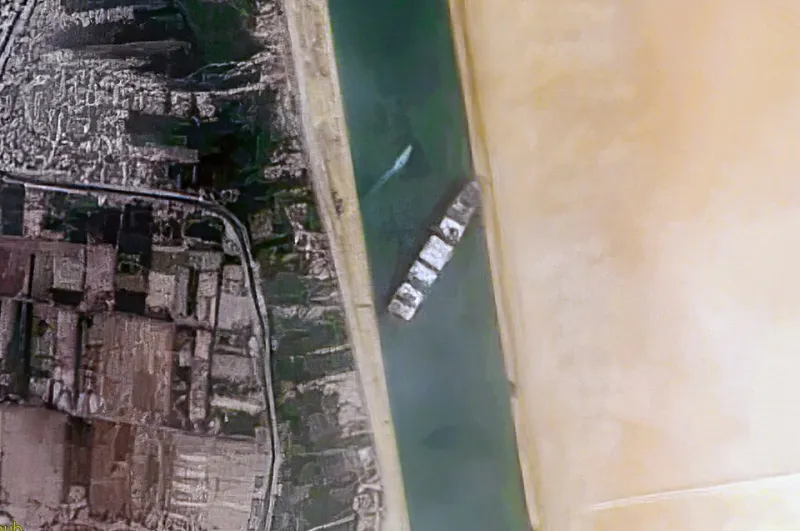
When the World's Busiest Shortcut Goes Dark: Life in Port Said During a Canal Shutdown
For most Americans, the Suez Canal is an abstraction — a geography class memory, maybe a news alert that pops up when something dramatic happens there. But in March 2021, that abstraction suddenly got very real. A container ship called the Ever Given got wedged sideways across the canal and stayed there for six days. Within hours, cable news was running live helicopter footage. Within days, economists were calculating losses in the billions. Within weeks, Americans were reading stories about delayed shipments, empty shelves, and rattled supply chains.
For the people of Port Said, though, a canal closure isn't a news event. It's a lived experience — one that reshapes daily life in ways that are hard to fully appreciate from the outside.
The Canal's History of Going Dark
The Suez Canal has been shut down twice in its history for extended periods, and both closures were caused by war rather than accident. The first came in 1956, during the Suez Crisis, when Egypt nationalized the canal and military conflict followed. It stayed closed for several months. The second — and far longer — closure ran from 1967 to 1975, a direct consequence of the Six-Day War between Egypt and Israel. For eight years, the canal sat idle, its waters home to a small fleet of international cargo ships that became known as the Yellow Fleet because of the desert sand that settled on their hulls.
That eight-year closure forced the world to adapt. Shipping companies rerouted around the Cape of Good Hope at the southern tip of Africa — adding thousands of miles and weeks to transit times. Fuel costs spiked. Freight rates climbed. Trade patterns shifted. It was, in effect, a full-scale rehearsal for what a prolonged modern closure would look like, though the global economy was far less interconnected then than it is today.
What Port Said Residents Actually Remember
Umm Hassan, a 71-year-old Port Said native, was a teenager during the 1967 closure. She remembers the city going quiet in a way that felt unnatural. "Port Said is a city built on movement," she says, sitting outside her apartment near the old commercial district. "When the ships stopped coming, it was like the city held its breath. The port workers had nothing to do. The shops that sold to sailors had no customers. Everything slowed."
Her son, Tarek, who now works as a logistics coordinator at the port, saw a smaller version of that same stillness during the Ever Given incident in 2021. "Six days doesn't sound like much," he says, "but you could feel it immediately. The traffic in the canal stopped. The radio channels went quiet. And everyone in the city knew — even if the news was calling it a minor disruption — that the numbers were going to be very large."
They were. Analysts estimated the blockage was holding up roughly $9.6 billion in global trade per day. Lloyd's List, a maritime intelligence firm, put the figure at closer to $400 million per hour for goods moving through the canal. By the time the Ever Given was freed, the ripple effects had already spread across multiple continents.
How It Hits American Consumers
Here's the part that tends to surprise people: a canal shutdown in Egypt can affect American consumers faster than almost any other global supply chain event. The reason is the nature of what moves through the Suez. About 12 to 15 percent of global trade transits the canal each year, including a significant share of the consumer goods, industrial components, and energy products that end up in the U.S. market.
When that flow gets interrupted — even briefly — the effects compound quickly. Ships that can't transit the canal either wait or reroute. Rerouting around Africa adds roughly two weeks to a Europe-Asia journey. That delay cascades through distribution networks, pushing back delivery windows for everything from furniture and electronics to car parts and clothing. Retailers who run lean inventory models (which is most of them, these days) have almost no buffer to absorb that kind of disruption.
During the Ever Given crisis, American businesses reported delays in shipments of everything from IKEA products to industrial machinery. Some smaller importers, already strained by pandemic-era logistics chaos, said the six-day blockage was enough to push them into back-order situations that lasted for months.
What the Contingency Plans Look Like
So what happens if the canal shuts down again — for longer? It's a question that maritime planners, insurance underwriters, and government trade officials think about more than the general public probably realizes.
The primary rerouting option remains the Cape of Good Hope passage, but it comes at a steep cost in time and fuel. Some bulk carriers and tankers use it routinely anyway, since the canal's size restrictions exclude the largest vessels. For container shipping, though, the economics of rerouting are painful enough that most companies would rather wait out a short closure than absorb the detour.
There's also the Suez Canal Authority's own contingency infrastructure to consider. After the Ever Given incident, Egypt accelerated investments in canal management technology, expanded the two-lane section of the waterway, and updated its emergency response protocols. The goal is to make future blockages shorter and less catastrophic — though no system can eliminate the risk entirely.
For American businesses, the lesson from recent disruptions has been a slow but real push toward supply chain diversification — more domestic sourcing, larger inventory buffers, and a closer look at alternative shipping routes and suppliers.
Port Said on the Other Side
For Port Said itself, every canal closure is a reminder of how tightly the city's identity is wound around the waterway. The port isn't just an economic engine — it's the reason the city exists. When it functions, Port Said thrives. When it doesn't, the effects are immediate and personal.
Tarek puts it plainly: "Every family here has someone who works in or around the canal. When it stops, you feel it at home that same night." It's a perspective that's easy to lose when you're reading economic analyses or watching cable news coverage from thousands of miles away. Behind every trade disruption statistic, there's a city full of people who were there — waiting, watching, and hoping the ships would start moving again.