The Invisible Hands: Meet the Pilots Who Steer the World's Most Important Ships
You've probably never thought about who's actually driving the ship carrying your new couch from China. Or the tanker hauling the fuel that eventually ends up in your car. But somewhere out on the water between Port Said and the Red Sea, there's a small group of Egyptian professionals doing one of the most high-stakes jobs on earth — and almost nobody knows their names.
They're called Suez Canal pilots, and every day they board some of the largest vessels ever built, take command of the bridge, and navigate roughly 120 miles of canal that connects two oceans and keeps the global economy moving.
What a Pilot Actually Does
Here's something most people don't realize: when a massive container ship pulls into Port Said harbor, the ship's captain doesn't steer it through the canal. A specially licensed Egyptian pilot — assigned by the Suez Canal Authority — boards the vessel and takes navigational control for the entire passage.
This isn't a formality. It's a legal requirement, and it exists for good reason. The Suez Canal is, in places, not much wider than a few ship lengths. Currents shift. Wind kicks up without warning. And the vessels these pilots board can be longer than the Empire State Building is tall, carrying tens of thousands of containers stacked stories high.
The pilot's job is to know this waterway so deeply — every curve, every sandbar, every quirk of tidal behavior — that they can move a 200,000-ton vessel through it safely, often in convoy with dozens of other ships doing the exact same thing.
Years of Training Before They Ever Touch a Wheel
Becoming a Suez Canal pilot isn't something you fall into. The Suez Canal Authority runs its own training academy, and candidates typically spend years at sea before they're even eligible to apply. Once accepted, trainees go through a rigorous program that combines classroom instruction in hydrology, meteorology, and maritime law with hundreds of hours of supervised on-water training.
They learn on simulators that replicate real canal conditions — including emergency scenarios like engine failure mid-passage or sudden sandstorm visibility drops. Then they shadow senior pilots on actual transits before they're ever allowed to operate independently.
The full certification process can take the better part of a decade. And even after certification, pilots are regularly evaluated, retested, and assigned to vessel types that match their experience level. A pilot cleared to handle a bulk carrier might need additional certification before boarding an ultra-large container ship.
The Pilot Boat: A Tiny Vessel with a Giant Responsibility
Before a pilot can board a ship, someone has to get them there. That's where the pilot boat crews come in — and their job is, in its own way, just as demanding.
Pilot boats operating out of Port Said are small, fast, and built for rough conditions. Their crews run around the clock, in all weather, ferrying pilots out to vessels anchored in the harbor or approaching from the Mediterranean. The transfer itself — climbing a rope ladder up the hull of a ship while both vessels are moving — is something that requires its own kind of nerve.
These crews are the first link in the chain. If a pilot boat is delayed, the entire convoy schedule gets thrown off. And convoy delays in the Suez Canal have a way of rippling outward very quickly — port operators in Rotterdam, logistics managers in Los Angeles, and retailers across the US can all feel the downstream effects within days.
Split-Second Decisions, No Room for Error
Ask anyone who's spent time around the canal, and they'll tell you: the part that looks calm from the outside is rarely calm on the bridge.
Pilots are constantly adjusting. They're communicating with canal traffic control, monitoring the ship's speed relative to the canal banks (which creates its own hydrodynamic pressure), watching for other vessels, and managing a crew that may not speak the same language. Most international shipping crews communicate in English, but coordination across cultural and linguistic lines under pressure is its own skill set.
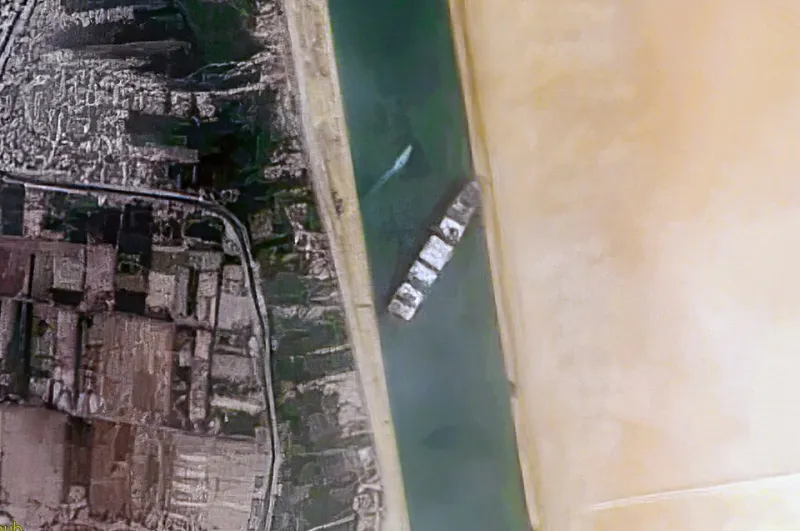
The Ever Given grounding in 2021 put the Suez Canal on the front pages of every American newspaper for a week. What that incident illustrated — besides how quickly a blocked canal can disrupt global trade — was just how precise and unforgiving the margins are. The canal doesn't offer much room to recover from a mistake.
Pilots will tell you that experience is everything. Knowing how a fully loaded VLCC (Very Large Crude Carrier) responds differently than an empty one. Knowing that wind hitting those stacked containers acts like a sail. Knowing when to slow down and when slowing down is actually the more dangerous option.
A Job That Never Really Clocks Out
The Suez Canal operates 24 hours a day, 365 days a year. Northbound and southbound convoys move in coordinated waves — which means pilots are working through the night, through holidays, through summer heat that can push past 100 degrees Fahrenheit on an open bridge deck.
For the people of Port Said, the pilots and their support crews are a source of quiet civic pride. They're not celebrities. You won't see them on billboards. But locals know what they do, and there's a deep respect for the profession that's been part of this city's identity since the canal opened in 1869.
If you're visiting Port Said and you spend any time watching the harbor — which you absolutely should — you might catch a glimpse of a pilot boat cutting through the chop toward an incoming vessel. It's easy to miss. But now you know what you're looking at: the beginning of a handoff that will carry goods across two continents, guided by someone who's spent their entire career learning exactly how to do it right.