One Canal, One Chokepoint: Why a Traffic Jam in Egypt Can Empty American Store Shelves
Photo: Contains modified Copernicus Sentinel data [2021], processed by Pierre Markuse, CC BY 2.0, via Wikimedia Commons
Stand on the northern breakwater in Port Said on any given morning and you'll see them — massive container ships queued up like cars at a toll booth, waiting their turn to enter the Suez Canal. It looks almost routine from shore. But what that line of vessels actually represents is staggering: billions of dollars in goods, thousands of supply chains, and the economic well-being of consumers on multiple continents, all funneled through a stretch of water barely wide enough for two ships to pass at certain points.
For most Americans, the Suez Canal is a geography class memory. But ask anyone who's tried to buy a new car, a piece of furniture, or a specific electronic device in the past few years, and they'll tell you — in frustration — that something somewhere is always backed up. More often than not, that somewhere includes Port Said.
The 2021 Wake-Up Call Nobody Forgot
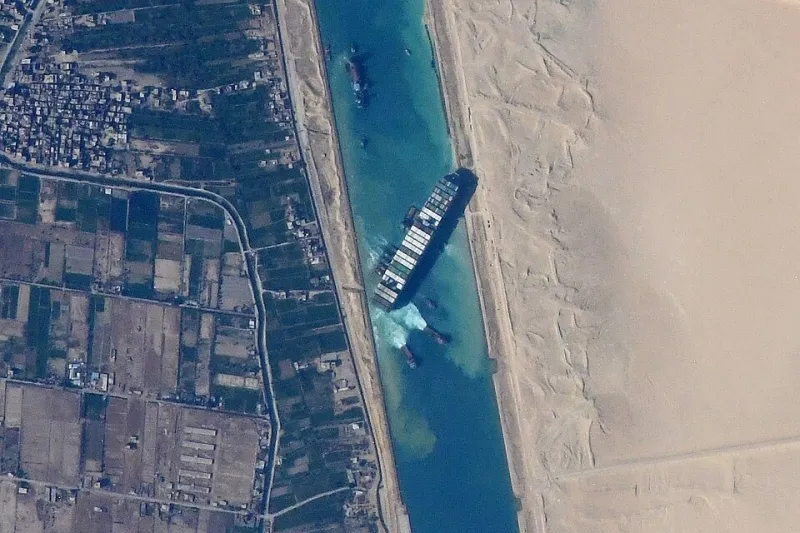
If there's one event that forced the Suez Canal into American dinner table conversation, it was March 2021. The Ever Given, a vessel roughly the length of the Empire State Building laid on its side, ran aground in the canal and stayed there for six days. Traffic stopped. Completely.
By the time salvage crews freed the ship, an estimated $9.6 billion worth of goods per day had been delayed. More than 400 ships were waiting to transit. The ripple effects hit everything from European car manufacturing to American coffee imports. Lloyd's List calculated the blockage was holding up roughly $400 million in trade every hour.
What made it worse wasn't just the jam itself — it was how fast the disruption spread. Modern supply chains are engineered for efficiency, not resilience. They run lean, with minimal buffer inventory. So when a single point fails, the consequences cascade globally within days.
Port Said, sitting at the Mediterranean entrance to the canal, was ground zero. Locals watched the news with the same disbelief as everyone else, even as the economic chaos played out in their own backyard.
Why Port Said Is the Canary in the Coal Mine
Port Said isn't just a transit point — it's a barometer for global trade health. When shipping activity here slows down, economists pay attention. The city's port authority handles everything from container transfers and bunkering (refueling ships) to crew changes and cargo inspections. The sheer volume of logistics coordination that happens here daily is mind-bending.
The canal itself connects the Mediterranean to the Red Sea, shaving roughly 7,000 nautical miles off the journey between Asia and Europe compared to going around Africa's Cape of Good Hope. For American importers sourcing goods from Asian manufacturers, that shortcut translates directly into delivery timelines and shipping costs.
When those costs go up — or when the route becomes unpredictable — US businesses absorb the hit first, and consumers feel it second.
Maritime Insurance: The Hidden Price Tag
Most Americans don't think much about maritime insurance, but it quietly shapes what they pay for almost everything. When geopolitical instability rises in or near the canal zone — think Houthi attacks on Red Sea shipping in late 2023 and into 2024 — war risk premiums spike almost immediately.
In early 2024, some shipping operators saw their insurance costs increase by as much as 400% for Red Sea and Suez transits. Many carriers chose to reroute around the Cape of Good Hope rather than absorb those costs or risk their vessels. That detour adds two to three weeks of transit time and significantly more fuel expense.
Those costs don't disappear. They get built into freight rates, which get passed to importers, which eventually land in retail prices. That premium on your next appliance or pair of shoes? Part of it might trace back to a risk assessment made in Port Said's shipping lanes.
Geopolitical Fault Lines Run Right Through Here
The canal has never operated in a political vacuum. Egypt controls it — and has since Nasser's nationalization in 1956, which itself triggered a military crisis involving Britain, France, and Israel. Today, the waterway's security is tied to Egypt's broader regional relationships, US foreign policy interests, and the stability of neighboring countries.
The Houthi campaign targeting commercial shipping in the Red Sea is the most recent example of how conflict hundreds of miles away can shut down a route that Americans depend on. Yemen's internal war became a shipping crisis became an inflation driver in the United States — all connected through the geography that Port Said anchors.
US military vessels have transited the Suez Canal during nearly every major Middle East operation since World War II. The canal isn't just a commercial artery; it's a strategic one. That dual nature makes it both indispensable and perpetually vulnerable.
What Would a Long-Term Closure Actually Mean?
Scenario planning is something shipping analysts take seriously, even if it sounds alarmist. A prolonged canal closure — whether from conflict, a catastrophic accident, or environmental factors — would force a near-total restructuring of global shipping routes.
For American consumers, the immediate effects would likely include:
- Longer lead times on electronics, apparel, and manufactured goods from Asia
- Higher retail prices across multiple product categories as freight costs spike
- Inventory shortages in sectors already running tight supply chains
- Energy price volatility as oil tankers reroute and delivery schedules shift
The US does have domestic production and alternative trade partners, but the reality is that American retail is deeply integrated with Asian manufacturing. Unwinding that dependency takes years, not weeks.
Port Said as a Lens on Global Fragility
There's something almost surreal about sitting in a café in Port Said, watching container ships drift past on their way to or from the canal, knowing that those floating metal boxes contain everything from the sneakers on American feet to the components inside hospital equipment. The city has lived with this reality for over 150 years — since the canal opened in 1869 — and its residents have a matter-of-fact relationship with the weight of it all.
For visitors, Port Said offers a rare chance to see global trade infrastructure not as an abstraction, but as a physical, human-scale thing. The ships are real. The pilots who guide them through are real. The stakes, when something goes wrong, are very real too.
Next time you're waiting on a delayed Amazon package or wincing at a price tag, it's worth remembering: somewhere off the coast of Port Said, the machinery of global commerce is either humming smoothly or straining under pressure. And right now, the whole world is watching.