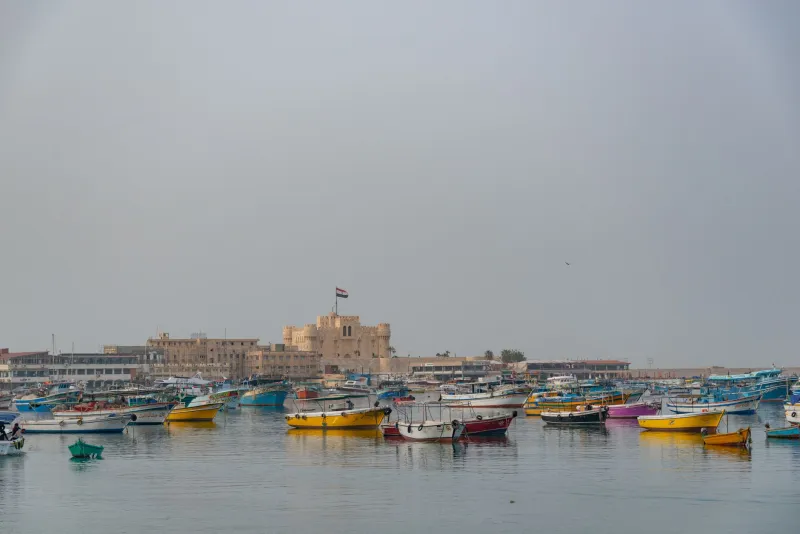
The City You've Never Heard Of That Ships You Almost Everything
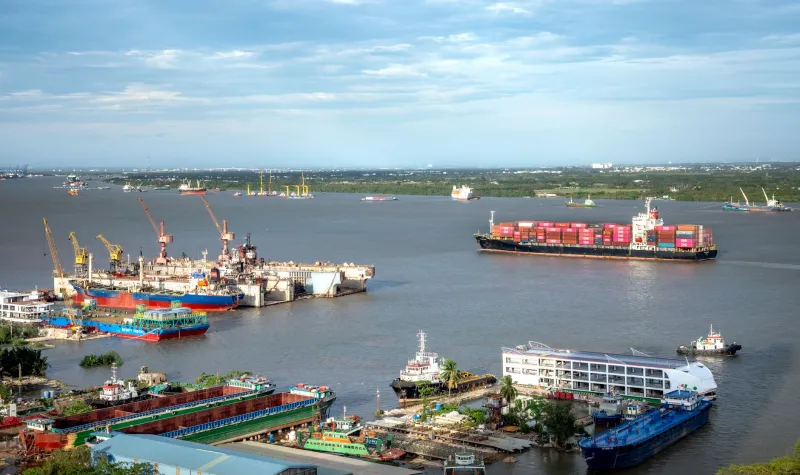
Pull up your last dozen Amazon orders. Now think about where the stuff actually came from — not the warehouse in New Jersey, but further back. The factory in Guangzhou. The textile mill in Bangladesh. The electronics hub in South Korea. Odds are, a significant chunk of those goods passed through a single Egyptian city before they ever touched US soil. That city is Port Said, and most Americans have absolutely no idea it exists.
That's not an insult to Port Said. It's more of a strange compliment. The city does its job so quietly, so efficiently, that its fingerprints on American consumer culture are almost completely invisible. But spend any time here, or talk to the logistics professionals who keep this place running 24 hours a day, and the scale of what happens at this northern gateway to the Suez Canal becomes genuinely hard to wrap your head around.
A Location That Was Always Destined for This
Port Said didn't stumble into its role as a global trade hub. The city was essentially built for it. Founded in 1859 as a construction base for the Suez Canal, it grew up alongside the waterway itself — which opened in 1869 and immediately rewired global commerce by cutting the Europe-to-Asia shipping route by roughly 7,000 miles. What used to require a months-long voyage around the Cape of Good Hope suddenly became a manageable trip through 120 miles of Egyptian desert.
For Port Said, geography was destiny. Sitting right at the canal's Mediterranean entrance, the city became the first and last stop for vessels moving between the Atlantic world and the Indo-Pacific. Over 150 years later, that geographic advantage hasn't gone anywhere. If anything, it's become more strategically valuable as global trade volumes have exploded.
Today, somewhere between 15 and 20 percent of all global seaborne trade passes through the Suez Canal. For the United States specifically, the canal serves as a critical artery for goods flowing from Asia — electronics, clothing, furniture, auto parts, appliances, toys. The list goes on. And at the top of that canal, managing the flow, sits Port Said.
More Than a Waypoint
Here's where a lot of people's mental model of Port Said falls short. It's easy to think of the city as simply a geographic checkpoint — ships pass through, they pay their fees, they move on. But Port Said has evolved into something far more active than a toll booth.
The Port Said Port Authority operates one of the most sophisticated cargo management systems in the Mediterranean. Real-time tracking technology allows port officials, shipping companies, and logistics coordinators to monitor vessel movements, cargo loads, and transit schedules with a level of precision that would have seemed like science fiction a generation ago. When a container ship carrying electronics from Shenzhen enters the northern approach, the downstream effects — on US port schedules in Los Angeles or Savannah, on warehouse staffing in Memphis, on retailer inventory systems in Chicago — begin calculating almost immediately.
This isn't abstract. Logistics professionals in the US who specialize in import supply chains will tell you that a 48-hour delay at Port Said can trigger a cascade that reaches American store shelves within days. Retailers who run lean inventory models — which is basically every major US retailer now — don't have the buffer stock to absorb unexpected slowdowns. When Port Said hiccups, America notices.
The Human Network Behind the Technology
For all the impressive tech infrastructure, what actually makes Port Said work is people. The city is home to a dense professional ecosystem built entirely around maritime commerce: canal pilots who navigate enormous vessels through tight passages, customs agents who process thousands of manifests daily, logistics brokers who speak fluent supply-chain on behalf of clients in a dozen countries, and ship chandlers who supply vessels with everything from fuel to food before they continue their journeys.
Walk the working waterfront in Port Said and you'll encounter a professional culture that feels genuinely international. English is widely spoken in business contexts, not as a courtesy but as a necessity — the global shipping industry runs on it. You'll hear conversations mixing Arabic, Greek, Filipino, and Mandarin within the span of a single block. The city has been cosmopolitan since the day it was founded, and that cultural fluency is part of what makes it function so effectively as a node in the global network.
Local families have built multi-generational businesses around the port economy. Ship supply companies, freight forwarding agencies, marine engineering firms — these aren't faceless corporations. They're often enterprises where the founder's grandchildren now manage the client relationships, carrying institutional knowledge that no software system can fully replicate.
When the System Gets Tested
The 2021 Ever Given incident — when a massive container ship ran aground in the Suez Canal and blocked traffic for six days — gave Americans a rare, jarring glimpse into just how dependent their consumer economy is on this particular corridor. Prices spiked. Delivery windows stretched. News anchors who had probably never uttered the words 'Suez Canal' before were suddenly explaining Egyptian geography to prime-time audiences.
Port Said was at the center of that story. The vessel convoy backups that formed at the canal's northern entrance were visible from the city's waterfront. Local maritime professionals worked around the clock coordinating with canal authority officials and shipping companies worldwide to manage the traffic jam. The incident was disruptive, but it also demonstrated something important: the human and institutional infrastructure in Port Said is designed to handle crises. The system bent. It didn't break.
A City Worth Understanding
For American travelers, Port Said tends to get overlooked in favor of Cairo's pyramids or Luxor's temples. That's understandable — those are world-class destinations. But there's something uniquely compelling about visiting a city whose entire identity is built around connecting the world.
The city's historic district still carries architectural echoes of its cosmopolitan colonial-era past. The waterfront promenade offers a front-row seat to one of the most dramatic shipping lanes on the planet — watching a fully loaded supertanker glide past at close range is an experience that recalibrates your sense of scale in ways that are hard to describe. And the food scene, shaped by generations of traders and travelers from across the Mediterranean and beyond, is genuinely excellent in ways that have nothing to do with logistics.
But maybe the most compelling reason to pay attention to Port Said is simpler than any of that. It's the city that quietly manages a huge piece of American daily life — the goods we buy, the prices we pay, the delivery windows we take for granted. Understanding how that system works, and where it lives, feels like something worth knowing.
Next time a package shows up at your door, there's a reasonable chance its journey included a stretch of Egyptian coastline most Americans will never see. Port Said was there. It almost always is.