The Dot on the Map That Runs the World: Why Port Said's Location Is Worth More Than You Think
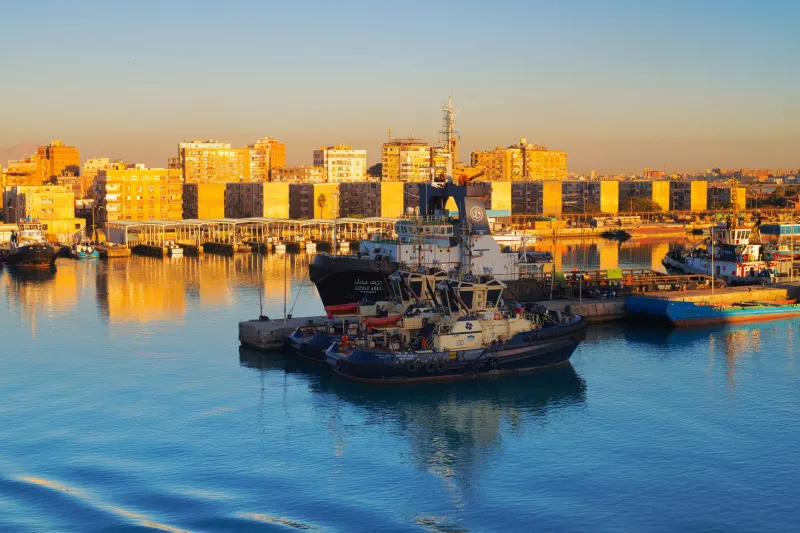
Pull up Google Maps and drop a pin at the northern tip of the Suez Canal. That's Port Said. It doesn't look like much from satellite view — a modest grid of streets pressed between the Mediterranean Sea and the canal's edge, roughly the size of a mid-tier American metro. But that pinpoint of geography might be the single most strategically loaded piece of real estate on the planet, and most people in the US have never given it a second thought.
That's worth fixing.
Where the Mediterranean Meets Everything Else
Here's the geographic reality that makes Port Said so unusual. The city sits at the exact junction where the Mediterranean Sea hands off to the Suez Canal — the 120-mile artificial waterway that connects Europe and the Americas to Asia, the Middle East, and East Africa without requiring a ship to sail around the entire continent of Africa. That detour, by the way, would add roughly 7,000 miles to most voyages. At current fuel costs and shipping rates, that's not a rounding error. That's a massive, economy-altering number.
Port Said doesn't just sit near this junction. It guards it. The city is positioned such that virtually every vessel entering or exiting the canal from the north passes directly through its waters. Pilots board ships here. Inspections happen here. Fuel, provisions, and emergency repairs are handled here. Before a container ship carrying your future Amazon order even enters the canal, Port Said has already touched it.
That's not symbolic. That's operational reality.
The Numbers Behind the Position
About 12 percent of global trade passes through the Suez Canal annually. Depending on the year and the commodity, that figure can climb higher — roughly 30 percent of global container traffic, and an even larger share of the oil and liquefied natural gas that heats homes and fuels cars across Europe and the eastern United States.
Break that down to a daily figure and you're looking at approximately 50 ships per day transiting the canal on average, carrying goods valued in the billions. Every single northbound vessel — the ones heading toward Europe and eventually toward US ports — clears Port Said on its way out. Every southbound ship heading toward Asia checks in here on the way in.
For Americans, the downstream effects of this are deeply personal, even if invisible. The electronics assembled in Vietnam, the clothing manufactured in Bangladesh, the auto parts shipped from South Korea — all of it is routed through a corridor that Port Said anchors. When shipping analysts calculate the cost of global trade disruption, Port Said's position is baked into every model they run.
Why This Specific Location Can't Be Replaced
It's worth asking: couldn't another city do this job? The short answer is no, and the reason is purely geological.
The Suez Canal exists because of a narrow strip of land — the Isthmus of Suez — that separates the Mediterranean from the Red Sea. That isthmus happens to be relatively flat and shallow, making it the only viable land route for a sea-level canal without locks anywhere between Gibraltar and the Indian Ocean. Port Said occupies the northern terminus of that corridor not by historical accident but because it's the only place where the Mediterranean coastline and the canal's path converge at a usable depth for large vessels.
There's no workaround. No competing geography. You either use Port Said, or you sail around Africa.
This is why, even as global trade routes shift and new players emerge, Port Said's relevance hasn't dimmed. If anything, it's intensified as ships have gotten larger and the volume of global commerce has grown. The city isn't riding the wave of modern trade — it's the shore the wave has to break on.
What This Means for the City Itself
Living in Port Said means living inside a kind of permanent economic paradox. The city is modest by the standards of major global trade hubs. It doesn't have the skyline of Singapore or the financial infrastructure of Rotterdam. But it carries an outsized economic punch that its street-level appearance doesn't immediately broadcast.
Local businesses benefit from a captive market of maritime workers, shipping professionals, and canal employees who cycle through constantly. The free trade zone established in Port Said — one of Egypt's most significant — exists entirely because of the city's location. Goods can be imported, processed, and re-exported with favorable tax treatment, attracting manufacturers and distributors who want a foothold at the top of the world's most trafficked waterway.
For residents, this creates a job market that's unusually connected to global economic conditions. When shipping demand spikes — as it did during the post-pandemic supply chain crunch — Port Said feels it immediately. When a major disruption hits (think the 2021 Ever Given grounding, which blocked the canal for six days and held up an estimated $9 billion in trade per day), the city is on the front line of both the crisis and the recovery.
The Geopolitical Layer
Beyond economics, Port Said's location gives it a geopolitical weight that far exceeds its population. Egypt controls the canal, and Port Said is the face of that control on the Mediterranean side. The city has hosted diplomatic negotiations, military coordination efforts, and international maritime conferences precisely because anything involving the canal inevitably involves Port Said.
For the United States specifically, the canal is a strategic asset that doesn't belong to us but that we depend on deeply. US Navy vessels transit the Suez regularly. American military logistics in the Middle East run through it. The economic relationship between US consumers and Asian manufacturers is routed through it. That means Port Said, almost by default, is a city the US government watches closely — even if American tourists rarely show up.
What You'd Actually Find If You Visited
Here's the part that surprises most first-time visitors: Port Said doesn't feel like a global trade nerve center when you're walking its streets. The waterfront promenade is calm and breezy. The architecture carries traces of its colonial-era past — elegant European-influenced buildings that reflect the city's history as an international crossroads long before container shipping existed. The food scene is genuinely excellent, leaning heavily on fresh Mediterranean seafood. The people are used to outsiders in the way that only port cities ever truly are.
It's a real city, lived in by real people, with neighborhoods and schools and weekend routines. The fact that it also happens to sit on one of the most strategically important coordinates on Earth is something residents carry with a kind of quiet, matter-of-fact pride.
If you want to understand global trade — not the abstract version taught in economics classes, but the physical, logistical, boots-on-the-ground version — Port Said is where you come. The map doesn't lie. Everything flows through here, and it always has.